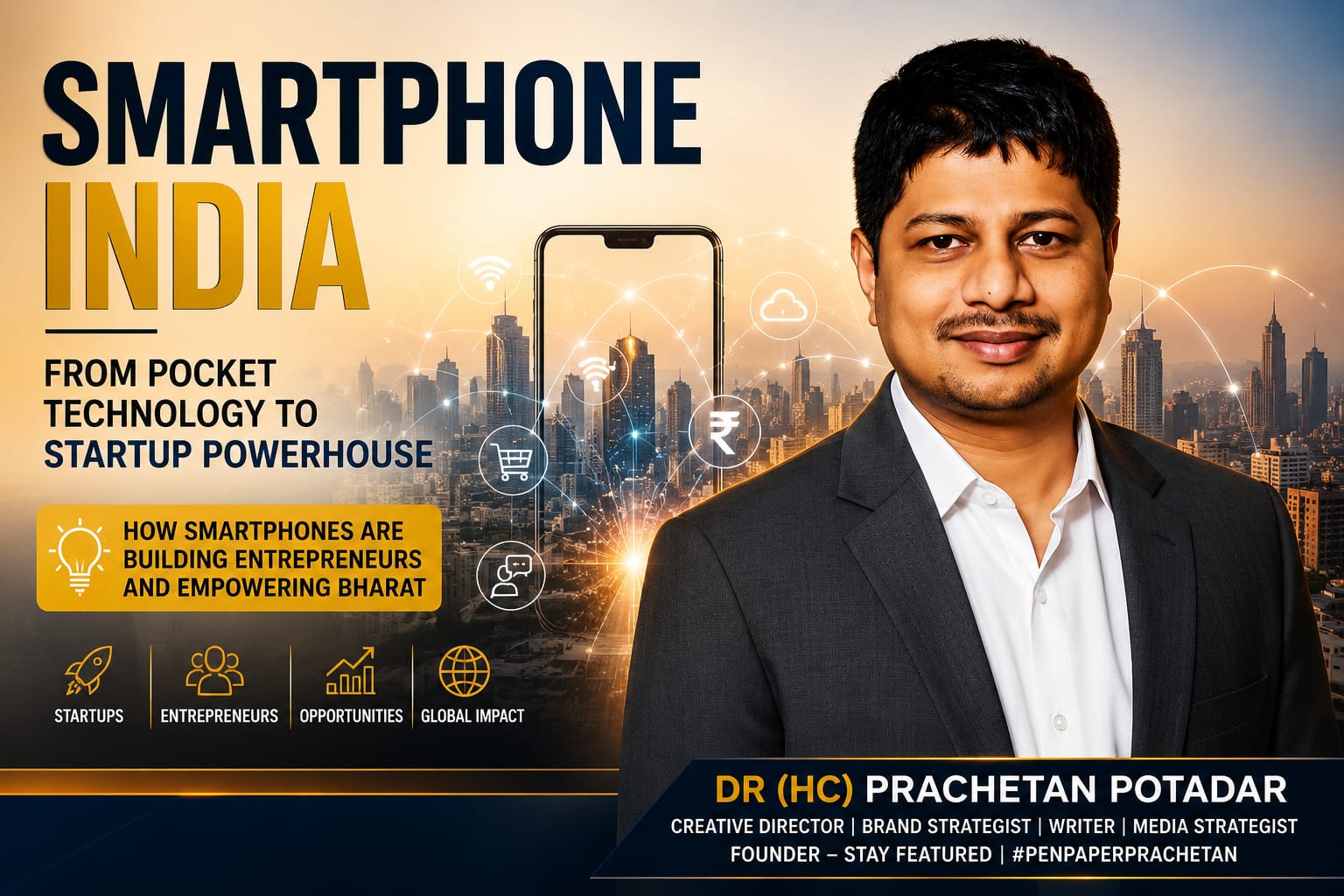
India’s smartphone story has moved far beyond communication. In 2026, the smartphone has become a gateway to entrepreneurship, digital commerce, payments, content creation, artificial intelligence and global markets. For millions of Indians, the first business office is no longer a rented room—it is a device in their hand.
From Smartphone Users to Entrepreneurs
A young entrepreneur today can create a brand, shoot a product video, communicate with customers, accept digital payments, advertise on social platforms and manage operations—all through a smartphone.
This transformation is happening alongside the remarkable expansion of India’s startup ecosystem.
As of June 2026, India had crossed 2.3 lakh DPIIT-recognised startups, with more than 23 lakh direct jobs generated. Nearly 50% of recognised startups are emerging from Tier-II and Tier-III cities, demonstrating that entrepreneurship is moving beyond traditional hubs such as Bengaluru, Mumbai and Delhi.
The smartphone is one of the key enablers of this decentralisation.
The Smartphone Market Is Changing
India remains one of the world’s most important smartphone markets, but 2026 has brought an interesting shift.
Counterpoint Research reported that India’s smartphone shipments declined 10% year-on-year in Q2 2026, marking the biggest June-quarter decline in six years. Rising component and memory costs have contributed to higher device prices and weaker demand.
Yet the decline in volumes does not tell the complete story.
Consumers are increasingly moving towards higher-value devices, while AI capabilities, cameras, connectivity and productivity features are becoming important differentiators.
In other words, India is moving from simply asking, “How many smartphones can we sell?” to “What can the next generation of smartphones enable?”
The Startup Smartphone
For an entrepreneur, the smartphone can simultaneously function as:
A camera.
A marketing studio.
A payment terminal.
A storefront.
A meeting room.
A customer-service desk.
A learning platform.
And increasingly, an AI assistant.
This has dramatically reduced the cost of experimentation.
A creator can test an idea before investing heavily. A small business can reach customers outside its city. A freelancer can serve clients across India. A startup can build its first community before building a large physical infrastructure.
From Bharat to the World
The next phase is not only about domestic consumption.
In August 2026, the Government expanded the “Source from India” feature on its Trade Connect ePlatform to eligible DPIIT-recognised startups, giving innovative Indian startups greater visibility among international buyers.
That creates an important entrepreneurial pathway:
Idea → Smartphone → Digital Market → Customer → Export Opportunity.
The AI Opportunity
Artificial intelligence is now becoming part of the smartphone experience itself.
For entrepreneurs, this could mean faster content creation, translation, customer analysis, marketing assistance, productivity automation and access to sophisticated digital tools without a large technology team.
But technology alone cannot build a sustainable company.
The real competitive advantage remains the ability to understand customers, solve meaningful problems and convert digital attention into trust and revenue.
Looking Ahead
India’s smartphone revolution is therefore evolving into something much bigger.
It is not simply about devices.
It is about economic participation.
The smartphone has helped move entrepreneurship from boardrooms to bedrooms, from metros to smaller towns and from physical storefronts to digital marketplaces.
India’s next great entrepreneur may not begin with a large office, a powerful network or substantial capital.
The journey may begin with an idea, an internet connection and a smartphone.
The real question for 2026 is no longer:
“Who owns a smartphone?”
It is:
“Who will build something meaningful with it?”
References
1. Government of India, PIB – Startup India ecosystem, 2026.
2. Government of India, PIB – Startup India and women-led entrepreneurship.
3. Government of India, PIB – “Source from India” access for DPIIT-recognised startups, August 2026.
4. Counterpoint Research – India Smartphone Market, Q2 2026.
5. Counterpoint Research – India Smartphone Market, Q1 2026.
About the Author
Dr. (HC) Prachetan Potadar, known as PenPaperPrachetan, is a Creative Director, Brand Strategist, advertising and PR professional, media strategist, writer and founder of Stay Featured. With honorary doctorates in Media Management, his work explores the intersection of technology, entrepreneurship, branding, consumer psychology and storytelling. Through his writing, he examines how emerging technologies are transforming Indian businesses, creators and communities.
0 Comments